|
| Introduction to RFieldbus Project |
Furthermore, the recent technological developments are pulling fieldbus networks to support a new wide class of applications, such as industrial multimedia applications. Examples of such applications for the industrial environment include video, audio, file transfer, WWW, etc. These kinds of applications can be supported by the TCP/IP protocol, which is widely used, vendor independent, standardised, and interoperable with almost every operating system.
One example of the integration of wireless and multimedia in PROFIBUS is reflected in the IST (Information Society Technology) project RFieldbus (High Performance Wireless Fieldbus in Industrial Multimedia-Related Environment), supported by the European Commission. This paper presents a field trial that was implemented to validate the RFieldbus approach for integrated wireless and wired communication in the factory floor, and to support multimedia streams and mobile nodes.
The RFieldbus Approach
One of the major targets of the RFieldbus system is to extend the traditional industrial communication platforms in the direction of the wireless industrial networking. The aim of this extension is to integrate an extended set of services and some additional functionality in the traditional real-time and dependable communication services, ranging from industrial multimedia capabilities to the mobility of services and devices.
For that purpose, new radio technologies were integrated with the existent PROFIBUS protocol, providing a flexible, hybrid (integrating wired and wireless segments) fieldbus network. In order to maintain compatibility with existent solutions, there is only one access control mechanism for all the different wired/wireless segments, meaning that there is only one token rotating between all the masters. Since only one node is able to communicate at a given instant of time, mobility handoff mechanisms can be simplified, bypassing the usually complex handoff mechanisms that are based on registration and location awareness information. In this approach it is not mandatory to have node location information since all messages are broadcast throughout the overall network. Thus, the handoff mechanism may be reduced to channel assessment and switching.
TCP/IP over PROFIBUS
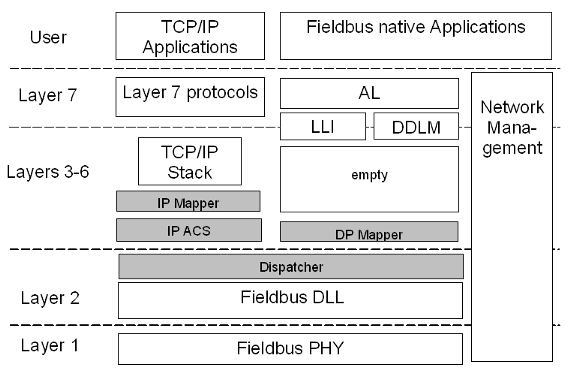
RFieldbus also aims at providing support to new industrial-related multimedia applications. Since these applications can be transparently supported by using the TCP/IP protocol, it was therefore of paramount importance to integrate TCP/IP into RFieldbus. The integration of TCP/IP traffic within the RFieldbus system had to be correctly specified, in order to provide not only the adequate Quality of Service to the supported TCP/IP applications but also to guarantee the timing requirements of the PROFIBUS control-related traffic. Furthermore, other details that needed to be assessed were:
|
The IP-Mapper sub-layer resides directly below the TCP/IP Protocol Stack mapping the TCP/IP services into the PROFIBUS DLL services. It performs the identification, fragmentation and re-assembly of the IP packets to/from PROFIBUS DLL frames. This layer is also responsible for the integration of the client/server model of the IP protocol into the fieldbus communication model. Since the communication model of PROFIBUS is master-slave, it is required to provide extra functionalities to compensate the lack of initiative in slave stations.
The Admission Control and Scheduling (ACS) sub-layer is responsible for the control/limitation of the network resources usage by the TCP/IP applications. Each IP packet is classified examining IP Header fields like destination address and port. Given this classification the corresponding fragments are placed in a specific queue. Moreover, this sub-layer implements the appropriate scheduling policies, in order to provide the desired Quality of Service for the multimedia applications.
The DP Mapper module is responsible for identifying the type of DP traffic, feeding the appropriate dispatcher queue, accordingly to the DP priority.
The Dispatcher sub-layer interfaces the PROFIBUS DP Mapper and the IP ACS to the PROFIBUS DLL. For transmission, it provides several queues concerning the priority of service requests. The Dispatcher transfers requests from these queues to the DLL, limited by the master allocation time. The requests are transferred at least within the Dispatcher Cycle Time and according to the queue priority.
|
The RFieldbus Project The RFieldbus Field Trial Applications Data streams Videos Photos Extras |